Built on SBA SOP 50 10 8.1, the FY2027 fee notice and published fee ranges
How Much Does It Cost to Buy a Business or Company and How Much Money You Need at Closing
Buying a business costs the purchase price plus roughly 7% to 14% more in fees, diligence and working capital, on our worked examples. If you finance it with an SBA 7(a) loan you do not pay the price in cash: you need about 15% to 22% of it at closing, made up of the 10% minimum down payment, the professional fees and the working capital the business needs on day one. The calculator on this page shows the line items for your price.
MRR, churn and growth verified before listing · data room on request · no buyer success fee · from $99 a month
Cash you need at closing
All-in cost
SBA loan incl. guaranty fee
Payment at the SBA cap
- SBA guaranty fee (financed into the loan)
The loan is above the $5,000,000 maximum for one 7(a) loan. Add equity or conventional debt on top.
Educational estimate from published rules and fee ranges · not a lender or attorney quote
The price itself is set by earnings. BizBuySell’s Q2 2026 Insight Report tracked 2,117 US small business sales at a median sale price of $349,250, and SaaS businesses usually trade at 2x to 4x annual recurring revenue. The rest of this page is about what comes on top of that number, because that is the part buyers underbudget.
Buyouts is a marketplace for AI SaaS businesses with verified metrics. Buyer membership costs $99, $299 or $899 a month and there is no buyer success fee. We do not lend, hold escrow or act as your attorney.
The listings, metrics and deals shown across this site are illustrative product UI. Figures on this page are educational estimates built from published rules and fee ranges, labeled where they are our own arithmetic, and are not a lender, accounting or legal quote.
Most of the cost on top of the price is the buyer paying to find out whether the numbers are true. Verified numbers shrink that bill.
Read from each source directly, 12 October 2026
What each source says buying a business costs on top of the price
Nobody publishes an audited average for closing costs on small business purchases. These are the figures a buyer is likely to meet, and they do not agree.
Swipe to see every column →
| Source | What it says | Basis | Date |
|---|---|---|---|
| Surge Business Law | Total acquisition costs run 25% to 40% more than the purchase price; legal $1,800 to $10,000 or more; 3 to 6 months of operating expenses as working capital | A law firm’s guide with two worked examples | Published 11 Mar 2026 |
| BizBuySell Insight Report | Median sale price $349,250 across 2,117 US sales | Broker-reported closed deals | Q2 2026 |
| SBA SOP 50 10 8.1 | 10% minimum equity injection; outside valuation above a $350,000 price; quality of earnings report at $3,000,000 or more | The rulebook for 7(a) loans | In force from 1 Oct 2026 |
| SBA Information Notice 5000-881797 | Guaranty fee 2% to 3.75% of the guaranteed portion by loan size, payable from loan proceeds | FY2027 fee notice | Loans from 1 Oct 2026 |
| Buyouts worked examples | 15% to 22% of the price in cash at closing; 7% to 14% all-in on top of the price | Our arithmetic below, labeled as such | 12 Oct 2026 |
The 25% to 40% figure and our 7% to 14% are not as far apart as they look. Surge budgets three to six months of operating expenses as working capital, which on a labor-heavy main street business can be a fifth of the price on its own; we use 5% of the price as a default because a SaaS business with annual prepayments often needs much less. Change the working capital slider in the calculator and you can reproduce either number. What neither of us counts is the broker commission, which the seller pays out of proceeds.
Our own math, labeled as such
What buying a business costs at four prices with an SBA loan
Our arithmetic using the calculator’s defaults: SBA 7(a) loan with the 10% minimum down, a software business, 5% of the price as working capital, no standby seller note, FY2027 guaranty fee financed into the loan, prime at 7.00% plus the SBA maximum spread over 10 years.
Swipe to see every column →
| Purchase price | Cash at closing | All-in cost | Monthly payment |
|---|---|---|---|
| $250,000 | $55,000 (22.0% of price) | $285,062 (price + 14.0%) | $3,435 at 13.00% |
| $750,000 | $143,000 (19.1%) | $833,188 (price + 11.1%) | $9,121 at 10.00% |
| $2,000,000 | $330,500 (16.5%) | $2,178,625 (price + 8.9%) | $24,423 at 10.00% |
| $4,000,000 | $665,500 (16.6%) | $4,364,250 (price + 9.1%) | $48,879 at 10.00% |
Two things move these numbers more than anything else. A seller note on full standby can cover up to half of the 10% down payment, which cuts the cash at closing on a $750,000 deal from $143,000 to $105,500. And the fixed fees weigh much more on small deals: legal, a code review and the packaging fee are about the same on a $250,000 business as on a $750,000 one, which is why the smallest deal carries the highest percentage. Paying all cash for the $750,000 business needs $812,500 at closing and costs 8.3% on top of the price, because there is no guaranty fee, valuation or packaging fee. If your lender finances the fees and working capital inside the project, as many do, the cash at closing drops toward 10% of the whole project instead.
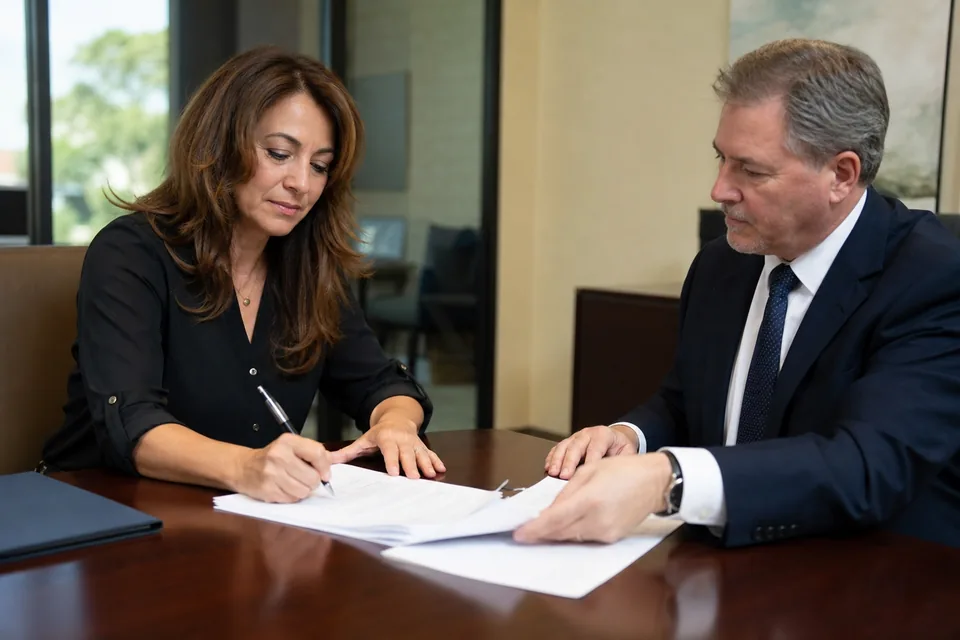
The price is the number in the listing, the cash is the number at the closing table
Most first-time buyers budget for the down payment and are surprised by everything else on the settlement statement: the lawyer, the valuation the lender orders, the packaging fee, the review of the code, and the cash the business needs on day one to make payroll before the first customer invoice is collected.
None of those lines is large on its own. Together they add 7% to 14% to the price in our worked examples, and almost all of it is paid in cash, not borrowed. The cheapest way to keep that bill down is to buy something whose numbers are already proven, because the diligence you do not have to repeat is the diligence you do not pay for. Every AI SaaS listing on Buyouts has MRR, ARR, growth and churn checked against the billing system before it goes live.
Side by side
Buying with verified metrics against budgeting from the asking price
A fair look at what each does well. Both are useful. Here is where they differ.
| Feature | Buyouts | Budgeting from the asking price alone |
|---|---|---|
| What the numbers rest on | MRR, ARR and churn checked against billing | The seller’s spreadsheet and tax returns |
| Diligence you still need | Legal and a code review; financial work starts from verified data | A full rebuild of the earnings, often a quality of earnings review |
| Cost to the buyer | $99 to $899 a month, no success fee | No membership, but more paid diligence per deal |
| Deals you pay to investigate and walk away from | Fewer, the numbers are visible before an LOI | More, problems surface after you have spent on diligence |
| Financing | You bring your own lender; lenders ask for the same metrics | You bring your own lender |
| Pays your closing costs | No | No |
Comparison reflects general, publicly understood positioning. Capabilities change, so check each marketplace for the latest. Trademarks belong to their owners.
Why founders and buyers pick Buyouts
One deal room built specifically for AI SaaS
How much money do you need to buy a business
With an SBA 7(a) loan, plan on cash equal to about 15% to 22% of the purchase price. The largest part is the equity injection, which SOP 50 10 8.1 sets at a minimum of 10% of the project for a first acquisition from 1 October 2026, with no waiver. The rest is fees and working capital, which a lender generally will not let you borrow from the seller. On a $750,000 software business that is $75,000 down, about $30,500 of fees for legal, the lender’s outside valuation, the packaging fee and a code review, and $37,500 of working capital, so $143,000 at closing in our example. Buy it all cash and you need the full price plus fees, $812,500. There are two honest ways to reduce the cash. A seller note on full standby, meaning no payments for the life of the SBA loan, can supply up to half of the 10% injection. And a business with annual prepayments or low payables needs less working capital than one that pays staff weekly and collects in 60 days.
The closing costs of buying a business, line by line
Legal fees come first. A corporate attorney who does small acquisitions bills roughly $250 to $400 an hour, and a clean asset purchase under $1,000,000 can close for under $10,000 in legal fees, while a deal with several sellers, assigned contracts or a stock purchase costs more. The calculator assumes $10,000 up to $500,000, $20,000 up to $2,000,000 and $35,000 up to $5,000,000. On an SBA deal the lender adds its own costs. Above a $350,000 purchase price SOP 50 10 8.1 requires an independent valuation from a qualified source, ordered by the lender; published fee ladders run from $1,900 to $3,900. The lender may charge a packaging fee, up to $2,500 flat without itemized documentation. The guaranty fee is the biggest SBA line, 3% of the guaranteed portion on a $675,000 loan, but it can be paid from loan proceeds, so it raises your loan rather than your cash. Then diligence. A quality of earnings review on a small deal runs about $5,000 to $30,000 and becomes mandatory on SBA deals at a price of $3,000,000 or more. For a software business a pre-LOI technical review costs around $5,000. Escrow is included on some marketplaces and costs roughly 0.5% to 1% on a private deal.
How much does it cost to buy a company with an SBA loan
The SBA caps both how much you can borrow and what the lender can charge. One 7(a) loan tops out at $5,000,000, so with 10% down the largest purchase a single loan supports is a little over $5,500,000 before fees. Variable rates are capped at prime plus 3.00% on loans above $350,000, which is 10.00% with prime at 7.00% since 17 September 2026, and higher on smaller loans: prime plus 4.50% from $250,001 to $350,000 and prime plus 6.00% from $50,001 to $250,000. That rate step is why the $250,000 example costs 13.00% and the larger ones 10.00%. On a small deal it is worth asking the lender to price below the cap, because the cap is a ceiling and many acquisition loans close under it. The other limit is cash flow. A lender sizes the loan to what the business can pay, testing debt service coverage at 1.15 times, and SOP 50 10 8.1 asks for 1.25 times on initial acquisitions numbered from 1 October 2026. A business that cannot cover the payment does not get the loan, whatever your down payment is.
Why the smallest deals cost the most in percentage terms
Most closing costs are fixed or nearly fixed. A lawyer charges about the same to paper a $250,000 asset purchase as a $500,000 one, a code review costs the same on a $300,000 SaaS product as on a $900,000 one, and the packaging fee does not scale. So on a $250,000 deal the fees alone are about 7% of the price before working capital, while on a $2,000,000 deal they fall below 2%. That has a practical consequence. If your budget is near the bottom of the market, it is easy to spend a large share of it investigating businesses you do not buy. A buyer who runs paid diligence on three $250,000 businesses before closing on the fourth can spend more on the three that failed than on the closing costs of the one that worked. The fix is to kill bad deals before you pay to investigate them, which is exactly where verified recurring revenue, churn and growth help. On Buyouts those numbers are checked against the billing system before a listing goes live, so the first screen is free and the paid diligence is spent on businesses that already passed it.
Costs after closing that buyers forget
Three costs arrive after the wire. The first is the transition: a seller consulting period is often priced into the deal, but if it is not, paying the founder to stay three to six months is real money. The second is the tools and accounts that move with the business, from cloud hosting and software subscriptions to new insurance policies in your name, which the lender will usually require before funding. The third is the first loan payment, due roughly a month after closing, before the business has necessarily sent you a dollar of profit. Budget the working capital so that it covers those three, not just payroll. A buyer who closes with the minimum cash and no cushion is one late customer payment away from funding the business from a personal credit card.
Keep reading on the parts of a deal this page touches: the business acquisition loan calculator with DSCR, every SBA 7(a) fee and the FY2027 guaranty fee tiers, the seller financing calculator, how to buy a business, stage by stage, what a SaaS business costs in ARR multiples, what a quality of earnings report costs, what an M&A attorney charges on a small deal, technical due diligence cost for a software deal, the SBA loan down payment in detail, the SBA lenders that make the most acquisition loans.
Good questions
The cost of buying a business, answered
More comparisons
See how Buyouts compares
Acquire.com alternative
An AI-SaaS-native marketplace with verified metrics, published multiples and vetted buyers, not a generalist startup listing wall.
vs FlippaFlippa alternative
A curated, metrics-verified, vetted-buyer marketplace for AI SaaS, not a high-volume auction wall.
vs MicroAcquireMicroAcquire alternative
An AI-SaaS-focused marketplace with verified metrics and real deal-flow tooling, not a generalist micro-startup feed.
vs Empire FlippersEmpire Flippers alternative
A self-serve, AI-SaaS-native marketplace with published multiples and escrow, not a content and eComm brokerage.
vs FE InternationalFE International alternative
A self-serve, AI-SaaS-native marketplace with verified metrics and published multiples, not a high-minimum sell-side advisory.
vs Quiet LightQuiet Light Brokerage alternative
A self-serve, AI-SaaS-native marketplace with verified metrics and published multiples, not a mid-market advisory engagement.
The deal room for AI SaaS, not a yard sale
Buy with verified metrics, published multiples and escrow-backed closes, or list your AI SaaS to a pool of vetted, capital-qualified buyers.
Listing figures are published by their sellers and self-reported · valuation content is educational, not a guaranteed sale price or return · trademarks belong to their owners